

 Leggi in Italiano
What changes when the United States targets the International Criminal Court, its judges, and the services that make its work possible
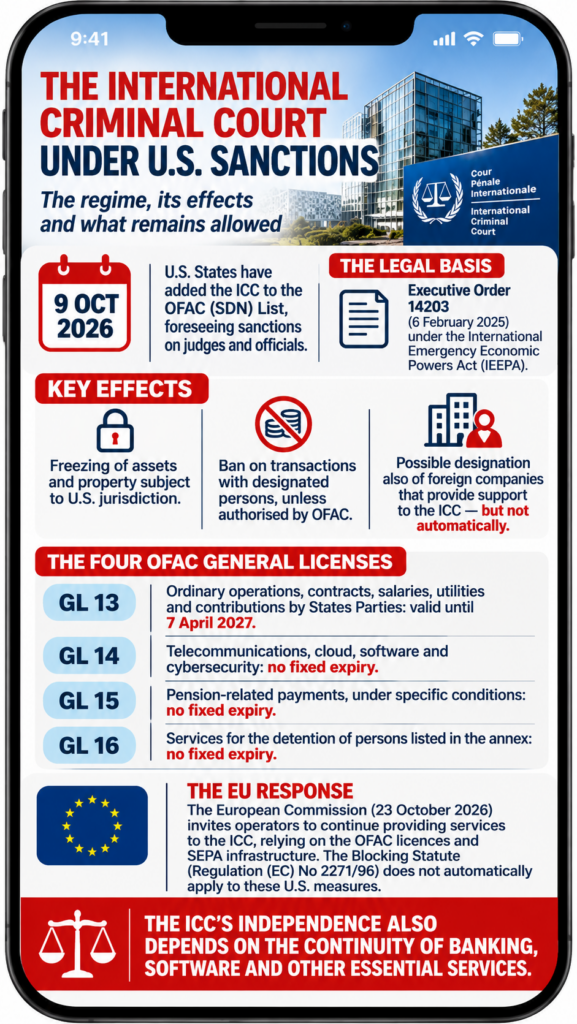
When we talk about the independence of a court, we almost always think about its judges: the pressures they may face, their freedom to decide cases, and their ability to work without fearing personal consequences. Yet a court also needs less solemn things. It must pay salaries, transfer funds, store documents, protect its IT systems, and enter into contracts. If a bank stops processing payments or a supplier decides that a commercial relationship has become too risky, a court’s independence begins to suffer long before anyone interferes with a judicial decision. It is at this seemingly mundane level that the American sanctions against the International Criminal Court (ICC) have acquired particular significance.
On 9 October 2026, the United States added the Court itself to the Specially Designated Nationals and Blocked Persons List (SDN List), administered by the Office of Foreign Assets Control (OFAC). Until then, the sanctions programme had mainly targeted judges and officials, one by one. Designating the institution places pressure on the economic relationships that enable it to function. Anyone with a contract involving the ICC — a bank, an insurer, a cybersecurity company, a software provider — must now establish which transactions are authorised. The announcement might suggest immediate and complete financial isolation. In fact, Washington simultaneously authorised a very broad range of the Court’s routine activities. This apparent contradiction provides a useful starting point for understanding the system. OFAC’s 9 October designation and licences.
Washington’s relationship with international criminal justice has always been difficult. The United States participated in the negotiations of the Rome Statute without becoming a party, and in 2002 adopted the American Servicemembers’ Protection Act, reflecting deep concern about the prospect of American nationals falling within the Court’s jurisdiction. That concern, however, has not produced an unchanging policy. In 2020, the first Trump administration introduced sanctions against individuals associated with ICC investigations, including Prosecutor Fatou Bensouda and Phakiso Mochochoko. Biden revoked the executive order and the related measures in April 2021. The administration’s explanation remains instructive: it reiterated American objections to the Afghanistan and Palestine investigations, while describing sanctions against Court personnel as inappropriate and ineffective. That episode shows that it is possible to contest a judicial body’s jurisdiction without concluding that those exercising it must be subjected to economic restrictions. US State Department statement, 2 April 2021.
The policy changed with Executive Order 14203 of 6 February 2025. Trump declared a national emergency under the International Emergency Economic Powers Act (IEEPA) and the National Emergencies Act, characterising certain ICC actions as an extraordinary threat to US national security and foreign policy. The order refers to proceedings involving American personnel and to the arrest warrants issued in November 2024 against Benjamin Netanyahu and Yoav Gallant. Washington maintains that the Court has unlawfully asserted jurisdiction over nationals of states that have not joined the Rome Statute. The disagreement is genuine and raises an important legal issue; it also needs to be stated precisely. Article 12(2) of the Rome Statute provides, among the ordinary preconditions for jurisdiction, for the territorial connection to a State Party or a state that has accepted the Court’s jurisdiction. Consent by the suspect’s state of nationality is therefore not invariably required. Disputes about the jurisdictional foundations of particular cases remain and deserve to be addressed through the appropriate legal procedures. The American order adopts a different understanding and attaches far-reaching economic consequences to it. Executive Order 14203; Rome Statute.
The sanctions mechanism is relatively straightforward in its basic structure. The property and interests in property of a designated person are blocked if located in the United States, brought there, or held or controlled by a US person. Under the order, US persons include US citizens and permanent residents, entities organised under US law, and persons present in the United States, subject to the order’s further specifications. Unless authorised, they cannot provide funds, goods or services to blocked persons, or receive them from such persons. The order also provides for restrictions on entry into the United States for certain categories of natural persons, potentially including specified family members. The programme is implemented through the International Criminal Court-Related Sanctions Regulations (31 CFR part 528), within the statutory framework of IEEPA. Breaches of applicable prohibitions may entail civil penalties and, where statutory requirements are met, criminal consequences. Karim Khan was designated in February 2025; other judges and officials were added in the following months. The European Commission’s communication of 23 October 2026 refers to thirteen ICC officials sanctioned before the institutional designation. OFAC programme; Commission notice.
To understand the exposure of a European company, another provision matters a great deal: section 1(a)(ii)(B) of the executive order. It allows the US authorities to designate foreign persons who have materially assisted, or provided financial, material or technological support, goods or services, in support of the activities identified in the order or of persons already blocked under it. This is where the programme’s potential extraterritorial reach becomes apparent. A foreign company may face designation even if it has not previously breached a prohibition applicable to a US person. It would be equally mistaken, however, to conclude that every ICC supplier is automatically sanctioned: designation requires a determination by the competent US authority under the order’s criteria. This risk should be carefully distinguished from the primary prohibitions already binding US operators and transactions with a relevant US jurisdictional connection.
There is also a difference between the law as written and the decisions of those who must decide whether to perform a contract. A European bank may have American counterparties; an IT company may rely on services, licences and infrastructure belonging to US businesses. Even in the absence of an immediately applicable prohibition, a firm may find it easier to terminate the relationship than to bear verification costs and reputational or commercial risks. This is the phenomenon often described as overcompliance or de-risking. Businesses may behave as though US law imposed a prohibition that, in the particular circumstances, it does not impose. The service can nevertheless disappear. When an international organisation is the target, such private decisions can become a major part of the sanctions’ practical effect.
Four licences to keep the Court operating
The designation of 9 October has an important feature: OFAC issued four general licences, numbered 13 to 16, at the same time. General licences authorise defined categories of operations without requiring each operator to seek an individual permit. They do not remove the ICC from the SDN List, and they do not indiscriminately protect all transactions. They do, however, prevent the blocking measures from immediately disrupting numerous essential services. This is an easy detail to overlook, although it is indispensable to an accurate account of the regime now in force.
General License 13 authorises, until 7 April 2027, transactions ordinarily incident and necessary to maintaining or winding down operations, contracts and agreements involving the Court. Its explanatory note mentions State Party contributions, salaries, medical and insurance services for personnel, rent, utilities, taxes, ordinary commercial services, subscriptions and payment of specified invoices. The Court’s blocked accounts may be used for those authorised transactions. Crucially, the licence does not automatically authorise transactions involving other, individually designated persons. The expiry date matters: an organisation can plan its activities, but it cannot assume that the present authorisation will remain available indefinitely. General License 13.
General License 14, which has no specified expiry date, covers telecommunications and enterprise software. Within the limits of the text, it allows email, videoconferencing, hosting, collaborative platforms, authentication services and software used for finance, payroll and other administrative work. It also covers cybersecurity solutions, data storage, backup and recovery, and cloud-based services including Software-as-a-Service supporting the listed functions. The detail of this list says something about the technological dependence of a modern court. The authorisation does not displace other federal rules, including export-control requirements, and does not automatically extend to dealings with every other blocked person. General License 14.
The remaining two licences are more specific. General License 15 covers the processing of pension payments involving the ICC, subject to special conditions where the recipient is blocked, including payment into a blocked interest-bearing US account. General License 16 authorises certain transactions necessary for the continued detention and care of the individuals expressly named in its annex, including health, safety and detention-facility services. Neither licence specifies an expiry date. Both must be read alongside the other applicable provisions and any specific authorisations: a general licence does not make every transaction connected to the Court lawful. General License 15; General License 16.
Europe and the limits of a political response
On 23 October 2026, the European Commission explicitly encouraged EU operators to continue providing services to the ICC, relying on the American licences and pointing out that SEPA payments operate through European infrastructure. Days earlier, the European Council had emphasised the importance of unimpeded access to financial and commercial services. I find it telling that a communication concerned with the protection of an international court must discuss bank transfers and commercial contracts: it gives a practical measure of the pressure sanctions can place on a judicial institution. The Commission’s encouragement does not, of course, amount to an exemption from US law. Operators must still assess whether the relevant service falls within an applicable authorisation and whether other designated persons or US jurisdictional links are involved. Commission notice, 23 October 2026.
The EU’s Regulation (EC) No 2271/96, usually called the blocking statute, has also entered the discussion. It seeks to counter certain extraterritorial effects of foreign legislation. Precision is important here. Its annex currently lists specified US measures concerning Cuba and Iran; the American sanctions against the ICC are not automatically covered. In October 2026 the Commission confirmed that extending protection was under consideration, without announcing that such an extension had been adopted. Even if the regulation were extended, a familiar difficulty would remain: a European operator may face conflicting legal expectations and continue to fear economic consequences in the United States. An EU measure can regulate what firms must do within the internal market; by itself, it cannot guarantee them uninterrupted access to American commercial relationships. Commission guidance on the blocking statute; Commission comments, 19 October 2026.
The legal question that remains is how far a state outside the Rome Statute may press its objection to the Court’s jurisdiction through economic measures capable of affecting the institution itself and its commercial relationships with companies in third countries. The Rome Statute, particularly Article 48, grants the ICC privileges and immunities necessary for its functions in the territory of States Parties; it also imposes cooperation obligations on those states. These treaty provisions do not bind the United States merely because other states have ratified them. Yet the United States’ non-party status does not settle every question about the international lawfulness of possible measures, particularly where they affect operators and activities beyond US territory. The jurisdictional bases claimed, any applicable international obligations and the implications for States Parties’ duty to cooperate must all be examined. These issues deserve analysis that assumes neither the wholesale unlawfulness of the sanctions nor their unquestionable legality.
One aspect of this episode continues to strike me. Pressure on an international court can be exerted through measures that no judge will ever receive on their desk. It may be enough for the businesses on which the Court depends to start treating an ordinary contract as a risk to be avoided. 7 April 2027, when the broadest general licence expires unless extended or modified, is therefore a date worth watching. In the meantime, the political and legal reality is already apparent: to continue many of its everyday functions, a treaty-based court must currently rely in part on authorisations issued by a state that contests its exercise of jurisdiction. That condition should prompt States Parties to think seriously about the material guarantees of judicial independence, beyond declarations of political support.
Principal sources: Executive Order 14203; OFAC programme and licences; 9 October 2026 designation; European Commission notice of 23 October 2026; Rome Statute; EU blocking statute.