
 Leggi in Italiano
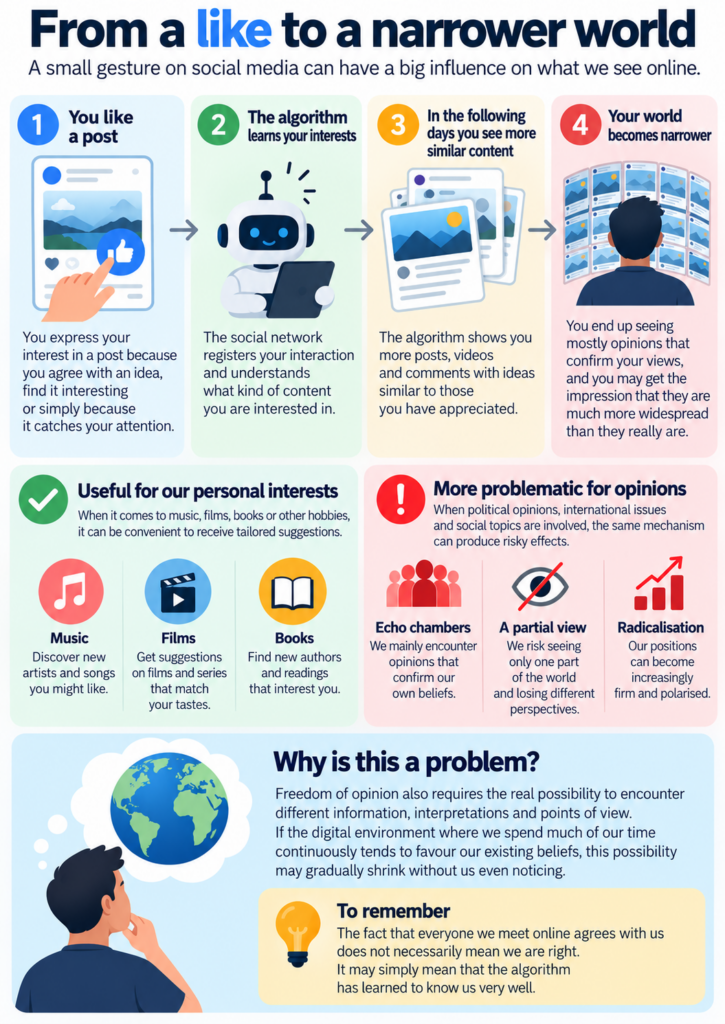
You know how it goes. You’re scrolling through a social network and you like a post because you agree with an opinion, find a topic interesting, or simply because something catches your attention. From that moment on, something curious can happen. Over the following days, you start seeing more and more content of the same kind: posts expressing similar ideas, people defending the same positions, videos and comments that seem to confirm what you already believe.
At first, you might not even notice. Then, gradually, you realise that your social media feed seems to be populated almost entirely by people who think like you. And you begin to get the impression that certain opinions are far more widespread than they actually are.
I find this mechanism rather troubling. I can perfectly understand its usefulness when it comes to music, for example. If I listen to a particular genre, I appreciate having Spotify or another platform suggest artists and songs I might enjoy. It’s a convenient way to discover new music without constantly having to search for it. The same can be true of films, books, or other personal interests.
Things become much more complicated when political opinions, international affairs, conflicts, immigration, or any other issue that shapes our understanding of reality come into play.
In these cases, the mechanism designed to offer us content likely to attract our attention can have considerably less innocent consequences. If an algorithm learns that I respond positively to a particular interpretation of events, it may keep showing me similar interpretations, perhaps increasingly forceful and provocative ones. And the more I engage with that content, the more I reinforce the process.
This is one of the mechanisms that can contribute to the formation of so-called echo chambers: environments in which we are exposed primarily to opinions that reinforce our existing beliefs. When we hear the same things repeated often enough, we begin to regard them as self-evident, almost beyond question. Different opinions gradually disappear from our information landscape and, when we do encounter them, they may strike us as absurd, incomprehensible, or even hostile.
What concerns me most is precisely this risk: gradually losing the ability to see the world through the eyes of people who think differently from us.
I don’t believe algorithms automatically turn people into extremists. That would be far too simplistic an explanation for a much more complex phenomenon. I do believe, however, that they can contribute to making our convictions more rigid, intensifying polarisation and, under certain circumstances, encouraging processes of radicalisation. This is particularly true when content that confirms our beliefs is accompanied by material designed to provoke outrage, anger, or fear.
There is another aspect I find particularly interesting. We often assume that we freely choose what we read and watch. In reality, a considerable part of our choices takes place within a selection that has already been made for us. Someone, or rather something, has decided which content to show us, in what order, and how frequently, according to criteria we only partially understand.
And this selection, repeated day after day, inevitably ends up influencing our perception of what is happening around us.
I wonder how aware we really are of this process. After all, freedom of opinion also depends on having a genuine opportunity to encounter different information, interpretations, and points of view. And if the digital environment in which we spend so much of our time constantly tends to reinforce our existing beliefs, that opportunity may gradually diminish without us even realising it.
Perhaps we should become a little more suspicious of social networks when they seem to agree with us all the time. The fact that everyone we encounter online seems to think like us does not necessarily mean that we are right. It may simply mean that the algorithm has become very good at figuring out who we are.